Review of the Concert on 2nd December 2023 by Colin Dowdeswell
| The Fairford and District Choral Society concert took us on a journey through oratorio excerpts through the ages. With helpful and carefully researched introductions to each item read by James Chute, the choir treated us to music, ranging from Vivaldi, Bach and Handel to Mozart, Mendelssohn and Fauré. The contrasting styles and moods made for a pleasingly varied programme, and the choir’s enthusiasm transmitted itself to the audience, despite the temperature in the Church. The choir’s conductor, Marysia Gorska-Saj, in this her final concert, did much to encourage the musical lines, and careful attention had been paid to speeds and dynamics. The choir was ably accompanied by organist Ian Crabbe, who contributed further variety with solos by Bach and César Franck. The final item, a spirited rendition of the Hallelujah chorus, brought the evening to a rousing conclusion. The smiles told of a concert well received. Colin Dowdeswell |
Review of the Concert on 1st April 2023 by SC
Review of the Concert on 3rd December 2022 by Hilary Taylor
We only usually associate the Messiah, Handel's Baroque oratorio with Christmas, but it was originally written for Easter, and first staged in Dublin in the New Music Hall, Fishamble Street at noon on April 13th 1742, doubtless to an audience as appreciative and spellbound as in St Mary's Fairford 280 years later. What a lovely performance. From the first notes of Tenor John Bacon's measured solo introduction, it was obvious that we would be in for a treat. I often think that local choral societies are seriously undervalued. It takes time and dedication to produce a big choral work like Messiah and to be able to see such a work in a local setting for such a reasonable price is wonderful. Where better than in Fairford's beautiful parish church? The rippling polyphonic lines-especially at speed-in this tremendous work are pretty taxing to sing, but the Fairford and District Choral Society under the direction of the brilliant Katrine Reimers managed it splendidly. The choruses were sensitively handled, with plenty of dynamic contrast and clarity of diction. Some of the entries can be challenging, but the choir sang them with confidence where I have sometimes heard groups falter... The acoustics suited the fine voices of the four professional soloists. They were engaging and commanded audience attention; the arias and recitatives in this piece deserved no less and the quartet of Charlotte Newstead-Soprano, Olivia Gomez-Contralto, John Bacon-Tenor and Bass Matthew Clark-who stepped in at the last moment, thank you Matthew! did full justice to Handel's masterpiece. Their solo performances were a pleasure to hear and most moving. This was storytelling matched in expressive content and nuanced, sensitive delivery. How lucky we were to have the opportunity to see such accomplished performers in a local setting. In the absence of an orchestral ensemble the accompaniment was well balanced between the heroic organist Robin Baggs, (I found myself wondering how many notes he had to play); and a well chosen, unobtrusive keyboard accompaniment. It was intriguing to see the keyboard played by Katrine while simultaneously conducting. This was no mean feat. The splendid insertion of Stephen Cutting's trumpet made a glittering, dramatic addition to the whole. My neighbour at the concert described it as, "Riveting." I could go on about my favourite passages, alas too difficult to choose, but not to mention the Hallelujah Chorus would be churlish. Totally uplifting, no wonder it is an all-time favourite-the entire company of voices together in a universal expression of triumphant joy, and why not? Bravo Fairford and District Choral Society for a beautiful start to the Christmas period. I haven't heard you before, but from now on I am a fan! Hilary Taylor |
Review of the Concert on 30th November 2024 by Wim Berenson
| The choral societies of Britain have been the backbone of the nation's music for several centuries, never more important than now with the worrying neglect of classical music in modern culture. So three cheers for Fairford & District Choral Society to be doing more than their bit to turn our minds to the amazing grandeur and sophistication of sacred music at its classical height, in their winter concert in St Mary's, Fairford. Angels and musicians look down from St Mary's renowned stained glass windows, and the church was extremely well filled for a rich banquet of Haydn, Mozart and Schubert works. Marvellous chordal textures, lovely melodic harmonies, exuberant rhythms, fearless high notes, these works speak of far more than the sacred Latin texts they use - here are three genius composers working at their very best to impress both God and their employers. Such works are not for the faint-hearted, being written for remarkable cathedral and court choirs and setting utmost challenges, which the Fairford singers rose to with the willingness that identifies the essential place of such societies in this country's musical continuity. The choir, some 50-strong, has powerful, well-tuned lower voices with fleets of altos, making a richer texture than some choirs can manage. The programme required much of the small band of sopranos, given thrilling lines written by the composers for the dynamic young choirboys of their day, and there were signs of strain here and there. Still, right the way from Haydn's exuberant Te Deum to the heights of Mozart's Solemn Vespers the capacity and musical ambition of the Fairford society was clear, if perhaps rebalancing the female sections looks worth considering. A quality quartet of soloists, linked via the sympathetic music director Nia Llewelyn Jones to Gloucester Cathedral, ensured some delightful moments in the exposed solo parts. The beautiful lyrical tenor voice of Will Renouccie phrased with particular musicality, and, amazingly, a single family provided the other three, all professional singers involved in the cathedral. Catherine and Nicholas Perfect offered mellifluous mezzo and bass voices, while their 16-year-old daughter, Harriet Perfect, delivered the important soprano solos of the Mozart and Schubert with astonishing volume, clarity and rock-steady tuning. Gloucester Cathedral must be delighted to have such an outstanding chorister, though she could learn to calibrate her volume better in ensembles. The bedrock of this admirable evening was the splendid organist Robin Baggs, who deserved the mighty cheers he received at the end of the concert. The attractive programme, translating all the texts, was another sign of an arts society that cares about both quality art and its community. |
Review of the Concert on 5th April 2025 by R.D.
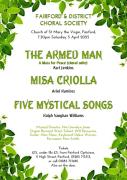
| The church of St Mary's Fairford was packed for the latest F&DCS concert. A palpable air of expectation prevailed, and expectations were richly fulfilled by the evening's performances, which were deftly and expressively conducted by Nia Llewelyn Jones. The first half of the concert was a performance of Sir Karl Jenkins' The Armed Man : a Mass for Peace. This large and impressive piece instantly became a modern classic as a work to mark the millennium, but in 2002 Sir Karl created a choral suite of the highlights, suitable for smaller forces. The choir rose to the occasion, and their commitment to the music was demonstrated immediately by their edgy interpretation of Rudyard Kipling's poem, Hymn before Action, a reflection on the agony of war, which stood in contrast to the pathos of the Kyrie. In the Sanctus and Benedictus the interplay of choir and organ was especially important, with many passages of syncopation. Bernard West on the organ ably reproduced the sound of distant trumpets, and Nia managed to keep it together, though it rocked slightly a few times. The long, sustained notes in the Hosanna were also a challenge for the singers, but for the most part they kept to pitch. The final section, God shall wipe away all tears, was a moving performance of these words from the Book of Revelation, which rounded off the suite like a Bach Chorale at the end of a cantata. The second half of the concert began with parts I and IV of the Koyunbaba Suite by Carlo Dominicone, played evocatively by Alan Shaw, with Djembe accompaniment. This exotic piece was an appropriate prelude to the next choral offering, Ariel Ramírez's Misa Criolla. The choir were joined by the tenor solo Will Renouccie for this thrilling Latin American setting of the Mass. A great sense of rhythm was essential to this work, as its movements are based on the rhythms of folk dances from Ramírez's native Argentina and from Bolivia. The tenor acts as a sort of cantor, whom the choir responds to, and Will Renouccie certainly gave off the aura of a gaucho turned priest. With the accompaniment of guitar, keyboard and percussion, the music evoked the pampas of South America, particularly in the Sanctus, where we could hear a horse's hooves. The choir were an excellent foil to the tenor solo, and even used the correct Latin American pronunciation of Spanish, for the extra twist of authenticity. By contrast, the programme ended with Vaughan Williams' much loved Five Mystical Songs, a setting of poems by the seventeenth-century poet George Herbert. Again, the choir sensitively accompanied the tenor solo for much of the piece, except for the very energetic conclusion, Let all the world. It was a suitably joyful ending to a very entertaining evening. 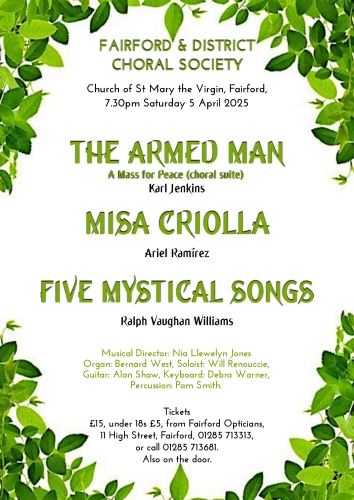 |