Review of the Concert on 5th April 2025 by R.D.

| Type of post: | Review |
| Sub-type: | No sub-type |
| Posted By: | James Chute |
| Status: | Current |
| Date Posted: | Sun, 11 Jan 2026 |
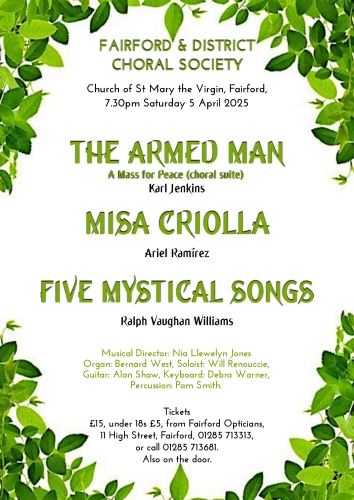
The church of St Mary's Fairford was packed for the latest F&DCS concert. A palpable air of expectation prevailed, and expectations were richly fulfilled by the evening's performances, which were deftly and expressively conducted by Nia Llewelyn Jones.
The first half of the concert was a performance of Sir Karl Jenkins' The Armed Man : a Mass for Peace. This large and impressive piece instantly became a modern classic as a work to mark the millennium, but in 2002 Sir Karl created a choral suite of the highlights, suitable for smaller forces.
The choir rose to the occasion, and their commitment to the music was demonstrated immediately by their edgy interpretation of Rudyard Kipling's poem, Hymn before Action, a reflection on the agony of war, which stood in contrast to the pathos of the Kyrie.
In the Sanctus and Benedictus the interplay of choir and organ was especially important, with many passages of syncopation. Bernard West on the organ ably reproduced the sound of distant trumpets, and Nia managed to keep it together, though it rocked slightly a few times. The long, sustained notes in the Hosanna were also a challenge for the singers, but for the most part they kept to pitch.
The final section, God shall wipe away all tears, was a moving performance of these words from the Book of Revelation, which rounded off the suite like a Bach Chorale at the end of a cantata.
The second half of the concert began with parts I and IV of the Koyunbaba Suite by Carlo Dominicone, played evocatively by Alan Shaw, with Djembe accompaniment. This exotic piece was an appropriate prelude to the next choral offering, Ariel Ramírez's Misa Criolla.
The choir were joined by the tenor solo Will Renouccie for this thrilling Latin American setting of the Mass. A great sense of rhythm was essential to this work, as its movements are based on the rhythms of folk dances from Ramírez's native Argentina and from Bolivia. The tenor acts as a sort of cantor, whom the choir responds to, and Will Renouccie certainly gave off the aura of a gaucho turned priest.
With the accompaniment of guitar, keyboard and percussion, the music evoked the pampas of South America, particularly in the Sanctus, where we could hear a horse's hooves.
The choir were an excellent foil to the tenor solo, and even used the correct Latin American pronunciation of Spanish, for the extra twist of authenticity.
By contrast, the programme ended with Vaughan Williams' much loved Five Mystical Songs, a setting of poems by the seventeenth-century poet George Herbert. Again, the choir sensitively accompanied the tenor solo for much of the piece, except for the very energetic conclusion, Let all the world. It was a suitably joyful ending to a very entertaining evening.
The first half of the concert was a performance of Sir Karl Jenkins' The Armed Man : a Mass for Peace. This large and impressive piece instantly became a modern classic as a work to mark the millennium, but in 2002 Sir Karl created a choral suite of the highlights, suitable for smaller forces.
The choir rose to the occasion, and their commitment to the music was demonstrated immediately by their edgy interpretation of Rudyard Kipling's poem, Hymn before Action, a reflection on the agony of war, which stood in contrast to the pathos of the Kyrie.
In the Sanctus and Benedictus the interplay of choir and organ was especially important, with many passages of syncopation. Bernard West on the organ ably reproduced the sound of distant trumpets, and Nia managed to keep it together, though it rocked slightly a few times. The long, sustained notes in the Hosanna were also a challenge for the singers, but for the most part they kept to pitch.
The final section, God shall wipe away all tears, was a moving performance of these words from the Book of Revelation, which rounded off the suite like a Bach Chorale at the end of a cantata.
The second half of the concert began with parts I and IV of the Koyunbaba Suite by Carlo Dominicone, played evocatively by Alan Shaw, with Djembe accompaniment. This exotic piece was an appropriate prelude to the next choral offering, Ariel Ramírez's Misa Criolla.
The choir were joined by the tenor solo Will Renouccie for this thrilling Latin American setting of the Mass. A great sense of rhythm was essential to this work, as its movements are based on the rhythms of folk dances from Ramírez's native Argentina and from Bolivia. The tenor acts as a sort of cantor, whom the choir responds to, and Will Renouccie certainly gave off the aura of a gaucho turned priest.
With the accompaniment of guitar, keyboard and percussion, the music evoked the pampas of South America, particularly in the Sanctus, where we could hear a horse's hooves.
The choir were an excellent foil to the tenor solo, and even used the correct Latin American pronunciation of Spanish, for the extra twist of authenticity.
By contrast, the programme ended with Vaughan Williams' much loved Five Mystical Songs, a setting of poems by the seventeenth-century poet George Herbert. Again, the choir sensitively accompanied the tenor solo for much of the piece, except for the very energetic conclusion, Let all the world. It was a suitably joyful ending to a very entertaining evening.